
NHL Free Bets UK: How to Use Bookmaker Welcome Offers on Hockey Markets
 Available in US

The biggest misconception I encounter about welcome offers and free bets is that they work the same way regardless of which sport you apply them to. They do not. Hockey in general, and the NHL and EIHL specifically, introduces a set of eligibility quirks, market restrictions, and timing considerations that can silently drain a bonus before you have placed a meaningful bet. The first time I claimed a free bet specifically to use on an NHL accumulator and discovered the combination of restrictions that effectively made it unusable for that purpose, I spent about 15 minutes reading terms I should have read before claiming. That was nine years ago; I have not made that mistake since, and this guide is my attempt to make sure you do not make it either.
The UK’s gross gambling yield for sports betting was approximately £2.48 billion in 2025, with football generating £1.1 billion of that on its own. Hockey sits in the long tail of betting turnover — but that also means operators are actively competing for the hockey-interested customer, which tends to produce genuinely competitive welcome offers rather than the token gestures that sometimes appear for truly niche sports. The market is large enough to attract resource. Understanding how to extract maximum value from that resource, without falling into the various traps that bonus terms create, is what this guide covers.
The Main Bonus Types and How Each One Behaves on Hockey
Bonus structure matters more than bonus headline amount, and nowhere is that clearer than when you try to use a bonus on a sport that sits outside an operator’s marketing focus. Here is how each common bonus type performs specifically on hockey markets.
Bet credits are the most common welcome offer structure at UK bookmakers. You deposit, place a qualifying bet, and receive a credit amount to use on further bets. The credit itself is not withdrawable — only winnings from bets placed with the credit can be withdrawn. For hockey purposes, the key question is whether the qualifying bet can be placed on hockey markets at the required minimum odds. Most operators require a qualifying bet at odds of 1.50 or evens (2.00) or higher; NHL moneyline prices for competitive games routinely satisfy this requirement. The bet credit amount is then usable on further hockey bets, subject to the markets being eligible and the minimum odds being met.
Free bets are structurally different. A free bet lets you place a wager without risking your own money, but if the bet wins, you receive the winnings only — the stake is not returned. A £10 free bet winning at 2.50 returns £15, not £25. This stake-not-returned structure means the effective value of a free bet is lower than its face amount, which affects how you should deploy it. For hockey, a slightly longer-odds bet — a puck line or totals selection at around 2.00 to 2.20 — typically extracts more value from a free bet than backing a short NHL favourite at 1.50, where the stake-not-returned penalty is proportionally more costly.
Enhanced odds are a promotional format where a specific outcome is offered at a boosted price, typically for a limited time window. These appear regularly on high-profile NHL games and occasionally on EIHL championship fixtures. The boosted price is almost always restricted to a specific maximum stake — typically £5 to £10 on a new account or £20 to £25 on an established one — which limits their aggregate value but makes them worth collecting consistently across a season if you are already intending to bet the game.
Acca bonuses and insurance work differently from the above because they apply to multi-selection bets rather than individual wagers. I cover these separately below because they have specific mechanics that interact with hockey markets in ways that are not obvious from the headline terms.

Welcome Offers and Hockey Eligibility: What to Check Before You Claim
Four questions need answers before you claim any welcome offer with the intention of using it on hockey. The answers will tell you whether the offer is worth claiming at all, and if so, how to sequence your bets to preserve the bonus value.
First: is hockey an eligible market for the qualifying bet? Most major UK operators include sports betting broadly, and hockey sits within that. However, some operators specify “UK and Irish sports” for their welcome offer qualifying bet — check explicitly that international sports including NHL are included. This is rare but it does happen, and discovering it after you have deposited is frustrating.
Second: are there minimum odds requirements that restrict which hockey bets can qualify? A qualifying requirement of 2.00 or higher on moneyline markets is manageable for competitive NHL matchups. A requirement of 3.00 or higher effectively narrows you to underdog bets, which changes the strategic logic of the qualifying stake.
Third: can the free bet or credit itself be used on NHL or EIHL specifically? Some operators restrict bonus funds to certain markets or leagues. “All sports” coverage at the qualifying stage does not always mean “all sports” at the bonus usage stage. Read both sets of terms — the qualifying terms and the bonus usage terms — as separate documents, because they can differ.
Fourth: what is the expiry window for the free bet or credit? Many welcome offers expire within 7 days of issue. NHL has games virtually every night during the regular season, so this is rarely a practical constraint. However, if you claim the offer during an NHL playoff bye week or during the EIHL summer break, and the only markets available are on sports you do not bet, the expiry window can catch you out.
The UK Gambling Commission’s data shows that approximately 10 percent of the UK population participates in online sports betting, with roughly 13.5 million active monthly online gambling accounts in the UK as of early 2025. That is a large pool of customers that operators are competing for, which creates genuine commercial pressure to offer meaningful welcome bonuses. The competition benefits you — but only if you read the terms before you act.

Which Markets Count: NHL Eligibility in UK Bonus Terms
The gap between “sports betting eligible” and “NHL eligible” is narrower than it used to be, but it still exists at some operators. Here is a practical map of the most common eligibility situations I have encountered across the major UK sports betting brands.
NHL match winner (moneyline) is almost universally eligible for sports betting bonuses at UK operators who cover the sport at all. If an operator has NHL in their sportsbook and their welcome offer applies to sports, moneyline NHL bets qualify for both the qualifying stake and the free bet usage in the vast majority of cases.
NHL totals and puck line have a slightly worse track record for bonus eligibility. Some operators explicitly list the markets that qualify for bonus usage, and specialised markets like totals or handicaps (including the puck line) may require a “standard markets” designation to qualify. If the bonus terms say “eligible for standard markets only,” checking whether totals and handicaps are classified as standard at your specific operator is worth the 60 seconds of reading time.
EIHL market eligibility for bonuses is less consistent. Some operators class EIHL as a niche market and exclude it from bonus usage while including NHL. This is inconsistent across platforms and can change with updated terms. The EIHL’s growing attendance and commercial profile has pushed several operators to improve their EIHL classification within bonus frameworks, but it is not yet universal.
Player props — goalie starts, anytime scorer — where they exist, are commonly excluded from bonus eligibility even when the match winner market is included. Same-game parlay availability with bonus funds varies widely and is often excluded at the specific bookmakers who offer the feature.
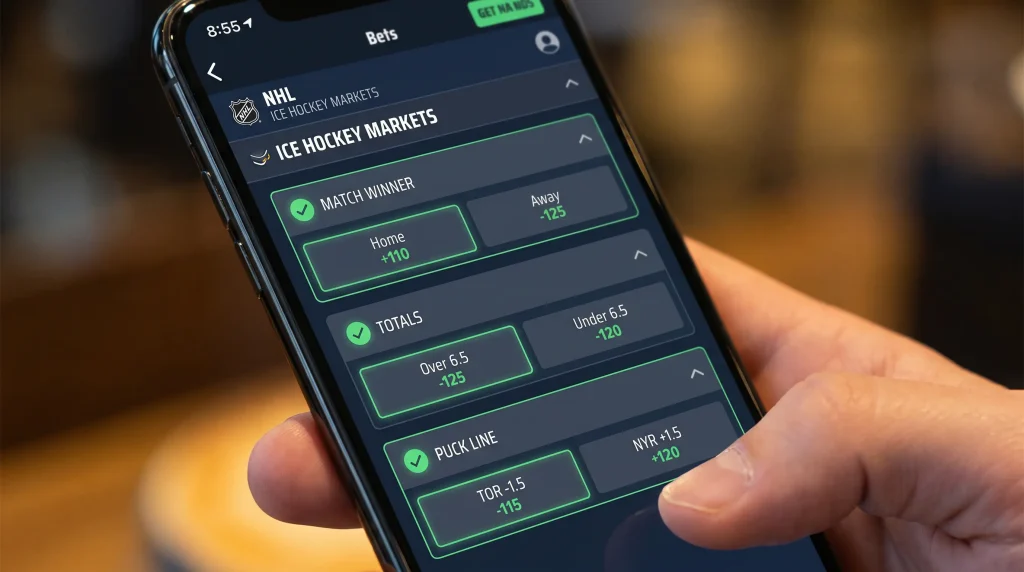
A practical approach: before claiming any offer with hockey in mind, open the full terms document and search for “ice hockey,” “NHL,” and “EIHL” to see whether they are mentioned explicitly. The absence of any mention is usually a positive sign — it means the market is treated as part of the general sports category rather than carved out for restriction. An explicit mention in a restriction clause is the red flag that demands a full read-through.
Acca Bonuses on Ice Hockey: How They Work and When They Are Worth Activating
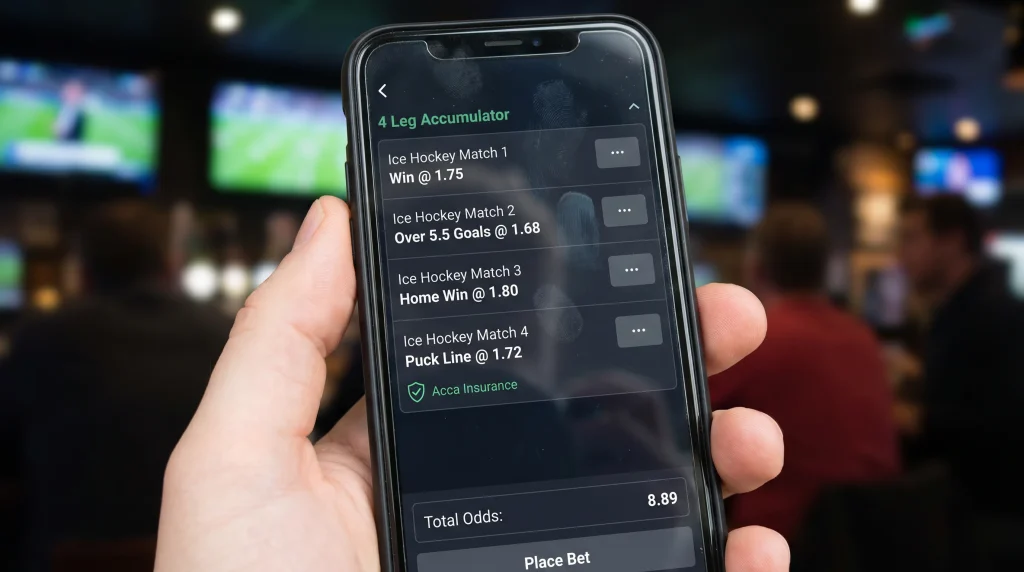
Accumulator bonuses in their most common form pay a percentage uplift on winning acca payouts. A 10 percent acca bonus on a five-leg winner pays you 10 percent more than the base acca return. On a five-leg NHL acca at average odds of 1.65 per leg, the base return on a £10 stake is approximately £12.80 profit. A 10 percent acca bonus adds £1.28. That sounds modest, but across a full NHL regular season of consistent acca activity, bonus uplift compounds meaningfully.
The specific challenge for hockey accumulators is that acca bonus thresholds — typically four, five, or six legs minimum — require finding enough eligible hockey events simultaneously. The NHL’s daily game schedule (usually 12 to 15 games per night) makes the supply side straightforward. The difficulty is identifying four or more genuinely independent selections with sufficient odds to produce a worthwhile payout while keeping the per-leg implied probability high enough that the accumulator covers at a meaningful rate.
Acca insurance — where one losing leg on an acca of four or more is refunded as a free bet — is one of the most valuable bonus formats for hockey specifically. In a sport where upsets are frequent and even strong favourites cover the moneyline only around 70 percent of the time, having insurance on one leg meaningfully changes the expected value calculation on an acca. The refund is typically the original stake rather than the full acca winnings, but receiving a free bet back after a near-miss is a genuine recovery of value rather than a consolation prize.
Andrew Rhodes, the UK Gambling Commission’s Chief Executive, noted in a February 2025 address that total gross gambling yield had reached its highest-ever level at £15.6 billion, and that operators were widening their sports offerings beyond traditional horseracing and football, including NHL and other US-based sports. That commercial shift is the context behind the expansion of bonus coverage to include hockey markets — and it is why now is a better time than five years ago to be looking for meaningful hockey-eligible promotional offers.
Enhanced Odds on Hockey: Recognising Genuine Value vs Marketing Noise
Enhanced odds promotions on hockey tend to cluster around the same two or three events: the Stanley Cup Final, the NHL All-Star Game, and the odd marquee regular-season rivalry matchup that a bookmaker has decided to market. Outside those flashpoints, genuine hockey price boosts are rarer than their football equivalents, which makes the ones that do appear worth paying attention to.
The test for whether an enhanced odds offer represents genuine value is simple: what is the original price, what is the boosted price, and what is the maximum stake allowed? A boost from 2.50 to 3.50 on a £5 maximum bet generates at most £5 of additional value. That is worth 60 seconds of your attention, not more. A boost from 2.00 to 3.00 on a £20 maximum is worth £20 of pure additional value above what you could get elsewhere, assuming you intended to back the outcome anyway. The second scenario is genuinely significant; the first is a marketing device dressed up as a promotional offer.
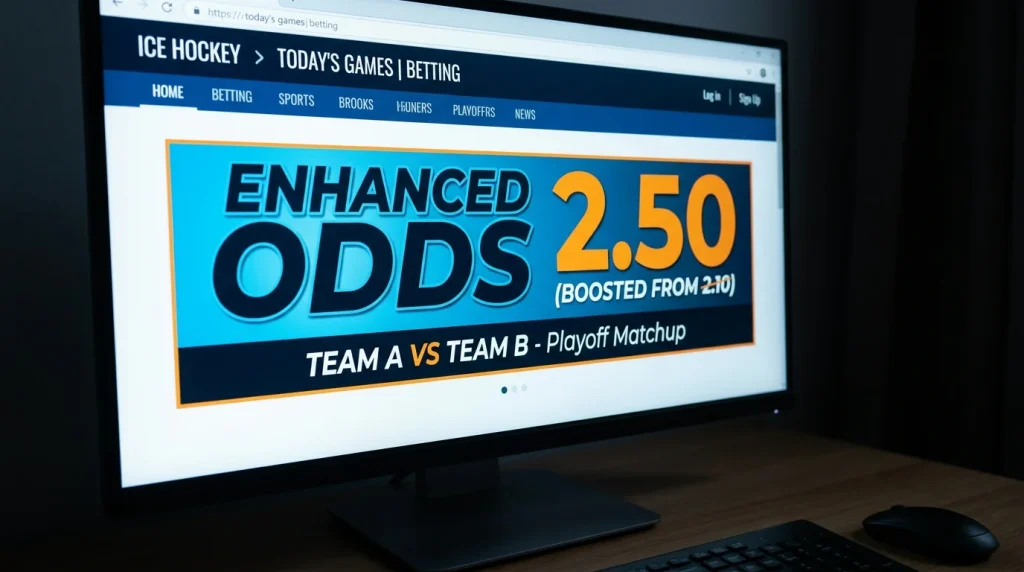
Enhanced odds on EIHL outcomes are rare. They tend to appear around high-profile playoff games and the occasional weekend showdown between the top clubs. When they do appear, the maximum stake restrictions are typically tighter than for NHL — reflecting the thinner market and the operator’s lower confidence in their pricing precision for British hockey. A £5 limit on an EIHL enhanced odds offer is common.
One practical note: enhanced odds offers on hockey frequently have a very short claims window — sometimes hours rather than days. Checking your preferred operators’ promotions pages on match day for any available hockey boosts is a habit worth building if you bet hockey regularly, because these offers appear and disappear quickly and are not always pushed as prominently as football promotions.
Wagering Requirements Decoded: What Actually Happens to a Hockey Free Bet
Wagering requirements are the mechanism that converts a free bet or bonus credit into withdrawable cash. Understanding the mechanics prevents the single most common bonus disappointment: winning with a free bet and then discovering you cannot withdraw the returns because the wagering requirement has not been satisfied.
Most UK welcome offers for sports betting carry a wagering requirement of between 1x and 5x, applied to the bonus amount. A “1x wagering” requirement on a £10 free bet means you must place £10 worth of eligible bets before the winnings are withdrawable. A “5x wagering” requirement means you must place £50 worth of eligible bets. Bet credits — where you receive £30 in credits on a £10 deposit, for example — often carry higher wagering requirements than free bet offers, sometimes up to 7x or higher.
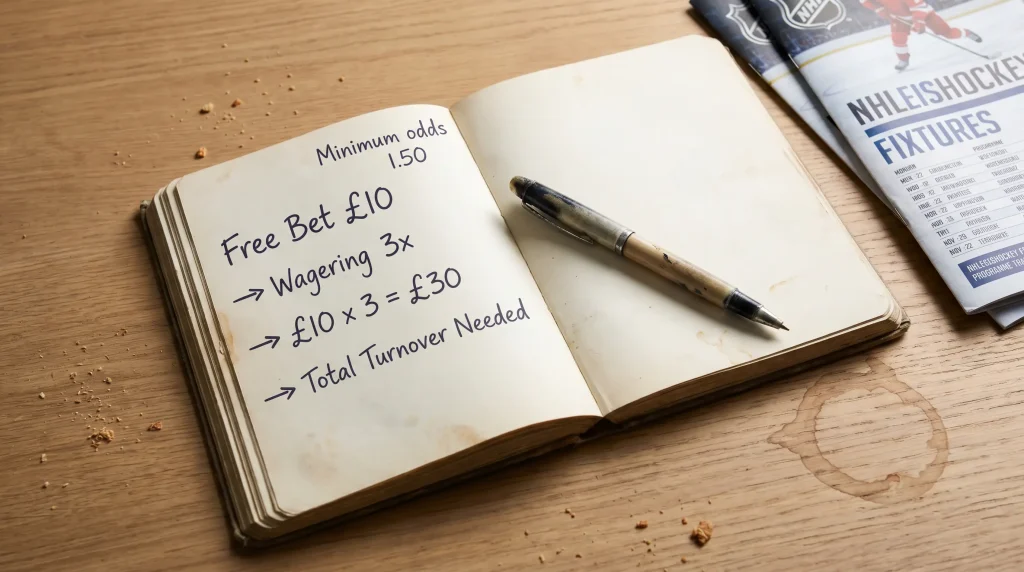
For hockey specifically, the calculation works like this. Say you receive a £10 free bet with a 3x wagering requirement at minimum odds of 1.50. You need to place £30 of eligible bets at odds of 1.50 or higher. If you bet three separate £10 NHL match winner bets at average odds of 1.80, you have satisfied the wagering requirement through those three bets regardless of whether they win or lose. The free bet winnings become withdrawable once the turnover threshold is met.
The edge case to know: most sports betting bonuses exclude the free bet stake from winnings calculations. So that £10 free bet winning at 2.00 returns £10, not £20 — the stake is not included. At 2.50 it returns £15. At 3.00 it returns £20. This stake-not-returned mechanic means deploying a free bet on a longer-odds selection typically extracts more gross value than deploying it on a short favourite, assuming you are comfortable with the associated probability.
How the 2025 Stake Limit Changes Affect Bonus Betting
From April 2025, UK regulations introduced mandatory online stake limits on slots: £5 per spin for players aged 25 and over, and £2 per spin for those aged 18 to 24. These limits apply specifically to online slot games and do not directly restrict sports betting stake amounts. That is an important clarification, because there has been confusion among some bettors about whether the regulatory changes affect how much they can stake on NHL or EIHL markets.
Sports betting stakes — including hockey — remain unrestricted in terms of a statutory maximum. An operator may impose their own stake limits on specific accounts or markets as a commercial decision, but this is separate from the regulatory slot limit and is applied at the individual operator level.
Where the 2025 changes do interact with bonus betting is through the affordability check framework. From February 2025, operators are required to conduct financial vulnerability checks on customers who deposit more than £150 within a 30-day period. These checks are triggered by deposit volume, not by the size of individual bets. If claiming a welcome offer requires a larger deposit to maximise the bonus match — some operators offer a 100 percent deposit match up to £50 or more — and that deposit pushes your 30-day total past the £150 threshold, you may be asked to provide financial information before the deposit is processed.
This is not a barrier to claiming welcome offers for most recreational bettors. It is simply a process to be aware of so you are not surprised by it. The affordability check is quick in the majority of cases and does not affect the offer validity, but it does add a step to the onboarding process that did not exist before 2025. For a full explanation of how the affordability framework works, including what information may be requested and how operators are required to handle it, the detailed guide on UK gambling regulations and ice hockey betting covers everything introduced in the 2025 reforms.

Are NHL matches included in standard welcome offer eligibility at UK bookmakers?
Yes, at the major UK operators who carry NHL markets, hockey is generally included in sports betting welcome offer eligibility for both the qualifying bet and the free bet or credit usage. EIHL eligibility is less consistent and worth checking separately at your specific operator. Specialised markets like player props may be excluded even when match winner and totals are eligible.
How do wagering requirements work when using free bets on ice hockey?
Wagering requirements specify how much you need to bet in total before bonus winnings can be withdrawn. For a £10 free bet with 3x wagering at minimum odds of 1.50, you place £30 of eligible bets at those minimum odds. The free bet winnings are withdrawable once that turnover is met. Note that free bet stakes are not returned on winning bets — a £10 free bet winning at 2.50 returns £15, not £25.
What is acca insurance and does it apply to hockey accumulators?
Acca insurance refunds your stake as a free bet if one leg of your accumulator loses, typically on accumulators of four or more selections. Whether EIHL and NHL markets qualify for acca insurance depends on the specific operator and their terms. Most major UK operators include sports markets broadly in acca insurance terms, but checking that hockey selections are eligible before building your acca is advisable to avoid a post-result disappointment.
Do stake limits introduced in 2025 affect the size of hockey bet bonuses?
The 2025 stake limits apply to online slot games only and do not directly restrict sports betting stakes. Welcome offer amounts and qualifying bet requirements at UK bookmakers are unchanged by the slot limit regulations. The affordability check framework — triggered by deposits above £150 in a 30-day period — can add a verification step to larger deposits but does not reduce the bonus amount itself.
Articles
Prepared by the Best Ice Hockey Betting Sites editorial staff.
