
Best Odds Comparison for Ice Hockey UK: Which Bookmaker Pays Out Most on NHL Bets
 Available in US

The best piece of advice I ever got from another hockey bettor—someone who’d been doing this profitably for longer than me—was this: never place an NHL bet without checking at least two prices. It sounds obvious. In practice, the friction of opening a second app before the pre-game markets close stops most bettors from doing it consistently. But the difference between a 1.72 and a 1.78 on a team you’re backing fifty times a season adds up to real money over hundreds of bets. Odds comparison is not optional if you’re serious about hockey betting in the UK.
This guide covers how bookmaker margins work on hockey markets, where the meaningful differences between platforms tend to appear, and how to build a practical comparison routine that costs you under two minutes per bet.
How Bookmaker Margins Work on NHL Moneyline
Every bookmaker prices a market with a built-in margin—often called the overround, vigorish, or juice. It’s the mechanism by which they ensure profit regardless of which side of a bet wins. Understanding it is basic numeracy for any bettor, but it’s worth being precise about what it means for hockey specifically.

On a two-way NHL moneyline, the margin works like this: add up the implied probabilities on both sides, and the total will exceed 100%. The excess over 100% is the margin. A game where the home team is at 1.70 (implied probability 58.8%) and the away team is at 2.20 (implied probability 45.5%) has a combined implied probability of 104.3%. That 4.3% is the bookmaker’s margin—the theoretical percentage of every pound bet that they expect to retain over time.
On standard NHL match winner markets, UK bookmakers typically operate between 4% and 8% margin. For the £2.48 billion UK sports betting market, those margins represent the fundamental economics of the industry. HM Revenue and Customs recorded £1.786 billion in provisional tax receipts from betting and gaming for the April to August 2025 period—up 9% on the same period the previous year—which underlines how systematically profitable the margin structure is for the industry.
For bettors, the implication is clear: every percentage point of margin you pay is reducing your expected return. Finding the platform with the tightest margin on any given bet is not trivial; it directly affects whether a positive-expected-value bet remains positive after the bookmaker’s cut.
NHL Odds Comparison: What the Numbers Look Like
Comparing specific prices across UK bookmakers on any given NHL game, you’ll typically find that the variation is small but consistent. For match winner markets on featured games, the spread between the best and worst odds available across major licensed platforms is usually 3% to 7% on favourites and 2% to 5% on underdogs. For less prominent games, the spread widens as fewer platforms actively trade the market and the competitive pressure that tightens prices is absent.
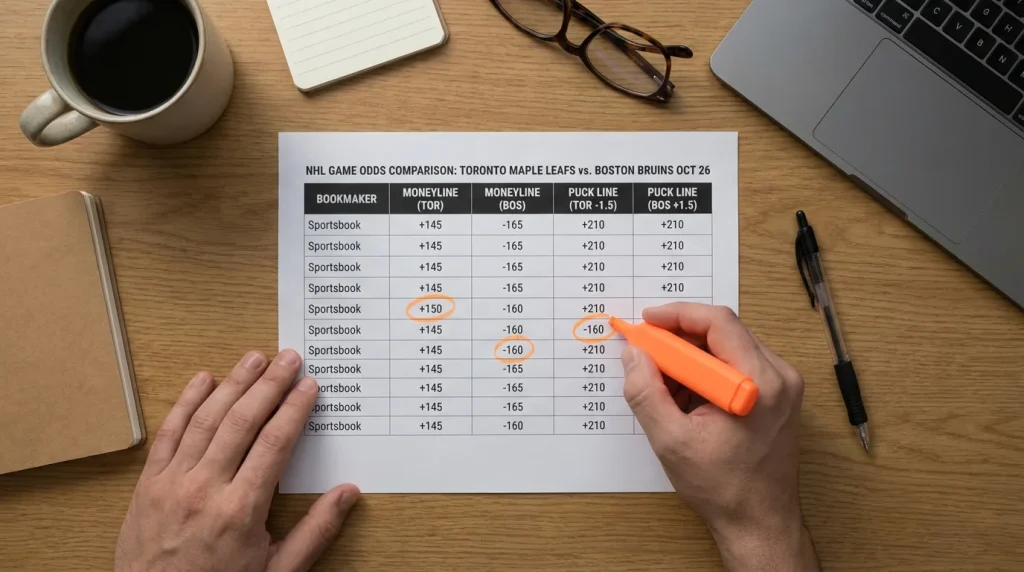
Puck line comparison tends to show slightly different patterns than moneyline. Because the puck line introduces a handicap element, the implied probability distribution changes—a -1.5 favourite might be priced at 1.90 at one bookmaker and 1.98 at another, a meaningful difference on a bet you’d place regularly. For bettors who work predominantly with puck line markets, comparing prices across two or three platforms before placing is even more important than for moneyline.
Totals markets on the same game can show variance of 0.05 to 0.15 between bookmakers, particularly for lines set at 5.5 or 6.0 where the true probability is close to 50/50 and bookmaker models may differ in how they’ve assessed the specific game context. The “best odds” on a totals bet isn’t always at the same platform as the best odds on that game’s moneyline.
EIHL Odds Comparison Across UK Platforms
The EIHL comparison picture is different because fewer bookmakers maintain active markets, and the ones that do vary significantly in their coverage approach. Some platforms set EIHL lines early in the week and leave them static until game time; others trade them more actively and update based on team news, injury updates, and goaltender confirmations.

For EIHL betting specifically, the margin variability between platforms is wider than for NHL—not because bookmakers deliberately price EIHL higher-margin, but because fewer of them are competing sharply for the business. Where two or three bookmakers all list the same EIHL fixture, you’ll regularly find meaningful price differences of 5% to 10% between the best and worst available.
The practical implication: for EIHL betting, finding the specific platform with the best odds matters more than for NHL, where the competitive pressure keeps margins tighter. Checking multiple licensed bookmakers for any significant EIHL wager is especially valuable.
Where to Consistently Find the Best Value Hockey Odds
There’s no single bookmaker that consistently offers the best odds across all hockey markets. The platforms that win on NHL moneyline sometimes lose on puck line. The one with the best futures odds might have wide margins on regular-season totals. This is why the practical advice is account diversity rather than platform loyalty.

Maintaining three or four UKGC-licensed accounts gives you a realistic price comparison capability across most hockey markets. The setup takes an hour once; the benefit compounds across every subsequent bet. For any bet above a certain stake—I’d set this at around £20, adjusted for your own scale—spending two minutes comparing prices is straightforwardly worth it.

The puck line specifically is a market where odds quality variation is significant enough to affect strategy. A team priced at 1.90 on the puck line at one bookmaker and 1.98 at another represents a return difference of 4.2% on the same bet—the equivalent of a meaningful fraction of the total market margin. For a detailed guide to how puck line markets are structured and when to use them, our puck line betting guide covers the strategic framework in full.
How do I calculate a bookmaker"s margin on an NHL moneyline bet?
Convert each side"s decimal odds to implied probability by dividing 1 by the odds. For a home team at 1.70: 1 / 1.70 = 58.8%. For the away team at 2.20: 1 / 2.20 = 45.5%. Add the two percentages: 58.8% + 45.5% = 104.3%. The amount over 100% is the bookmaker"s margin—in this case, 4.3%. A lower total means a tighter (better) margin for bettors.
Which UK bookmakers consistently offer the shortest margin on NHL games?
Margins vary by game and market type rather than consistently by bookmaker. Platforms that specialise in or heavily trade NHL markets tend to offer tighter margins on featured games. The most reliable approach is to compare prices on specific bets across two or three licensed platforms before placing—no single bookmaker consistently leads on all NHL markets. The competitive market means margins are generally reasonable across major licensed operators.
Does the overround on EIHL games differ from NHL?
Yes, typically EIHL markets carry slightly higher overrounds than NHL markets at the same platform. This reflects lower trading volume and fewer bookmakers competing sharply for EIHL business. Where multiple platforms list the same EIHL game, the price gap between best and worst available tends to be wider than for equivalent NHL fixtures. This makes price comparison across platforms more impactful for EIHL betting than for NHL.
Articles
Prepared by the Best Ice Hockey Betting Sites editorial staff.
