
Ice Hockey Totals Betting UK: Over/Under Markets, How to Read Them and Where to Bet
 Available in US
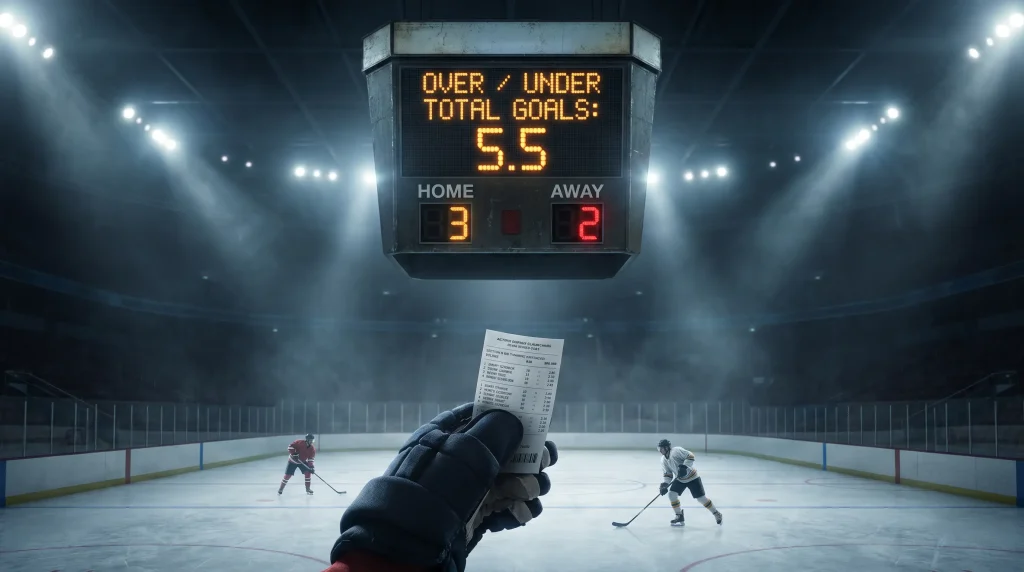
I’ve had more interesting conversations about totals betting than about any other hockey market. The reason is that it removes the question of who wins entirely, which is sometimes liberating and sometimes the whole problem. You’re not picking a team. You’re picking whether a game will be high-scoring or low-scoring, and the factors that determine that have nothing to do with loyalty or matchup preference. It’s pure analysis.
In the UK, over/under markets for NHL and EIHL hockey are available at most major licensed bookmakers. They’re often the second or third market listed after the match winner, and they reward bettors who pay close attention to goaltending form, team defensive structures, and scheduling context—things casual punters rarely track.
How Totals Work in Ice Hockey
The premise is simple enough that you can explain it in a sentence: bet on whether the combined goals scored by both teams will be over or under a line the bookmaker sets. If the line is 5.5 and the game finishes 3-2, that’s a total of 5 goals—under wins. A 4-3 finish gives you 7 goals—over wins. The half-goal lines (5.5, 6.5) eliminate the possibility of a push, which is why bookmakers use them almost exclusively for hockey.

What’s less obvious is that the total includes goals scored in overtime and the shootout—with one important exception. The shootout decides the game with one goal, and in most UK bookmaker rulings, only one goal counts toward the total from a shootout winner. So a game that’s 2-2 after regulation, 2-2 after overtime, and then settled 3-2 by shootout typically counts as 5 total goals, not more.
Always check the specific bookmaker rules before placing totals bets, particularly on EIHL games where rulings can vary. For NHL, the major UK platforms are generally consistent, but it’s worth the thirty seconds to confirm.
Common Totals Lines in the NHL
The standard over/under line for an NHL game sits at 5.5 or 6.0 at most UK bookmakers. That’s not arbitrary—it reflects the long-run scoring environment of the modern game. Over the course of a full NHL season, the average number of goals per game hovers around 5.8 to 6.2, making 5.5 or 6.0 a reasonable central estimate for any given fixture.

Where it gets interesting is the deviation from that baseline. A game between two strong defensive teams with elite goaltenders might be set at 5.0 or even 4.5. A matchup where both clubs are playing the second game of back-to-back nights, with backup goalies potentially in net, might push the line to 6.5. The spread of lines across any given night of NHL action tells you a lot about what the market knows about each game’s context.
The NHL recorded over 23 million attendees in the 2024/25 season, and the games that drive that attendance are typically high-energy, high-stakes affairs. Those aren’t always high-scoring. Some of the best games in recent memory have finished 2-1 in overtime. The entertainment value doesn’t correlate with total goals—which is something worth keeping in mind if you’re new to totals analysis and still intuitively drawn to “over” because high scoring feels exciting.
Factors That Shift the Totals Line
Let me give you the framework I use before placing any totals bet. There are four primary variables, and I weight them roughly in this order.

Goaltender form and status is number one, and it’s not close. A team with a starter who’s posting a save percentage above .920 is a very different totals proposition to one relying on a backup who comes in cold. When a high-end goalie is confirmed starting, I lean toward the under. When lineup news suggests a backup—especially on the road on the second night of a back-to-back—I reassess toward the over. There’s a reason experienced analysts describe goaltender matchups as one of the most critical factors in hockey betting: the difference between a .910 and a .930 save percentage across a full game of shots is typically one to two goals.

Team defensive structure comes second. Some clubs are built around possession and defensive zone control; others run an open, aggressive offensive system and concede chances freely. Head-to-head history between specific teams can reveal persistent stylistic tendencies that bookmakers don’t always fully price in.
Rest schedules matter more in hockey than in almost any other sport. Teams on back-to-back nights, particularly on road trips, show measurable declines in defensive zone coverage and goaltending performance. Fatigue-driven games trend toward the over more often than not, in my experience.
Finally, arena context. Certain venues historically produce higher or lower scoring than the league average. This isn’t a coincidence—ice surface conditions, altitude (in Colorado specifically), and even crowd effects on referee tendencies have documented influences on game scoring. Over nine years, I’ve found it’s worth maintaining a simple note on which venues trend consistently high or low.
Bookmakers for Totals in the UK
For NHL totals betting, the major UKGC-licensed platforms generally offer over/under lines for most games on a given night, with sharpest pricing on primetime Eastern Conference fixtures. The depth varies—some bookmakers list 10 to 15 totals markets per major game, including first-period totals and team-specific totals; others stick to the basic game total only.

EIHL totals are less consistently available. Some UK bookmakers list over/under for Elite league fixtures, but the selection is often limited to the higher-profile games rather than the full schedule. Where they do appear, the lines tend to cluster around 6.5 to 8.5, reflecting the somewhat higher scoring environment of British professional hockey compared to the more goaltender-driven NHL.
The totals market is one of the more transferable skills in hockey betting—the analytical framework applies whether you’re looking at an NHL primetime game or a Friday night EIHL fixture. Once you’ve built a working model for evaluating goaltender status, team structure, and scheduling context, you’re equipped to assess lines across both competitions. Understanding the puck line market adds another layer of nuance on top, since puck line and totals analysis share several common variables.
What is the standard total line for an NHL game at UK bookmakers?
The most common line is 5.5 or 6.0, reflecting the average scoring environment in the modern NHL. Lines move up or down based on goaltender matchups, team defensive structures, and scheduling context such as back-to-back nights. Games between defensive teams with elite starters can be set as low as 4.5, while high-pace matchups with backup goalies may be priced at 6.5 or higher.
Do overtime goals count towards the over/under total?
Yes, goals scored in overtime count toward the total. The shootout is the exception—typically only the single deciding goal in a shootout counts, not additional attempts. So a game that finishes 2-2 in regulation and is then settled 3-2 in a shootout usually counts as 5 total goals. Rules can vary slightly between bookmakers, so it"s worth checking the specific T&Cs before placing.
How does goaltender form affect the totals line?
Goaltender form is the single biggest variable in setting and evaluating totals. A team with a high-performing starter will typically see the line set lower, reflecting tighter expected scoring. When a backup goalie is confirmed—especially on a back-to-back road night—bookmakers and sharp bettors both adjust toward higher totals. Late lineup news about goaltender status can cause noticeable line movement before puck drop.
Articles
Prepared by the Best Ice Hockey Betting Sites editorial staff.
